After more than two decades in the spotlight, Beyoncé has become much more than a pop icon. She’s a cultural force who has routinely defied expectations and transformed the way we understand the power of art to change how we see ourselves and each other. But at 40, she feels like she’s just scratched the surface.
INTRODUCTION BY KAITLYN GREENIDGE; PHOTOGRAPHS BY CAMPBELL ADDY; STYLING BY SAMIRA NASR AND MARNI SENOFONTE
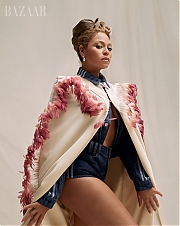
Women born at the dawn of the 1980s were among the last generation to live an analog life and the first to see themselves reimagined in digital. Beyoncé’s childhood coincided with the rise of home-recording equipment—video cameras, stereo systems that let you record your own voice, keyboards that let you find whatever sound you wanted, personal computers to synthesize it all. The girls before her had mirrors and the echoes of the trees and magazines with cartoon approximations to reflect themselves. Her generation was the first to regularly experience the dizzying accuracy of playback. It could be a destabilizing force; there’s your voice as you think it sounds, and then your voice when it comes back to you, after you’ve hit Record.
Beyoncé Knowles-Carter came of age during that digital revolution, and knowing how to navigate that dissonance is part of her artistic superpower. She has built her company, Parkwood Entertainment, into a media conglomerate that includes a fashion line, IVY PARK. She is now a mother of three, to nine-year-old Blue Ivy and four-year-old twins Rumi and Sir, with husband JAY-Z. The iconic couple has just been named the new faces of Tiffany & Co., which was acquired earlier this year by LVMH and is relaunching under its auspices. And she is working on new music along with an array of other projects that promise to obliterate old boundaries and vault her further into uncharted territory.
Is that what I sound like? Is that what I want to send into the world? These are questions she answers anew, each decade of her life. Now, at 40, Beyoncé listens to her voice alone.
You turn 40 on September 4. Reflecting on your life so far, what has each decade taught you?
The first decade of my life was dedicated to dreaming. Because I was an introvert, I didn’t speak very much as a child. I spent a lot of time in my head building my imagination. I am now grateful for those shy years of silence. Being shy taught me empathy and gave me the ability to connect and relate to people. I’m no longer shy, but I’m not sure I would dream as big as I dream today if it were not for those awkward years in my head.
I was competing in dance and singing competitions at age seven. When I was on the stage, I felt safe. I was often the only Black girl, and it was then that I started to realize I had to dance and sing twice as hard. I had to have stage presence, wit, and charm if I wanted to win. I started taking voice lessons from an opera singer at nine. By 10 I had already recorded at least 50 or 60 songs in the recording studio. This was before Pro Tools, when you recorded to tape.
I had my first vocal injury at 13 from singing in the studio for too many hours. We had just gotten our first record deal, and I was afraid I had developed nodules and destroyed my voice and that my career could be over. The doctors put me on vocal rest all summer and I was silent once again.
My teenage years were about the grind. I grew up hearing this particular scripture from James 2:17, “Faith without work is dead.” Vision and intention weren’t enough; I had to put in the work. I committed to always being a student and always being open to growth. No one in my school knew that I could sing because I barely spoke. My energy went into Destiny’s Child and the dream of us getting a record deal and becoming musicians. If something wasn’t helping me reach my goal, I decided to invest no time in it. I didn’t feel like I had time to “kiki” or hang out. I sacrificed a lot of things and ran from any possible distraction. I felt as a young Black woman that I couldn’t mess up. I felt the pressure from the outside and their eyes watching for me to trip or fail. I couldn’t let my family down after all the sacrifices they made for me and the girls. That meant I was the most careful, professional teenager and I grew up fast. I wanted to break all of the stereotypes of the Black superstar, whether falling victim to drugs or alcohol or the absurd misconception that Black women were angry. I knew I was given this amazing opportunity and felt like I had one shot. I refused to mess it up, but I had to give up a lot.
My 20s were about building a strong foundation for my career and establishing my legacy. I was focused on commercial success and number ones and being a visionary no matter how many barriers I had to break through. I was pushed to my limits. I learned the power of saying no. I took control of my independence at 27 and started Parkwood Entertainment. At the time, there wasn’t a company that did what I needed it to do or ran the way I wanted it run. So, I created this multipurpose badass conglomerate that was a creative agency, record label, production company, and management company to produce and work on projects that meant the most to me. I wanted to manage myself and have a company that put art and creativity first.
I pulled together these young visionaries and independent thinkers to collaborate with. I wanted strong women to be in key roles throughout my company, when most of the industry was still male dominated. I wanted collaborators who had not been jaded by the corporate world and wouldn’t be afraid to rock with me when I came up with unconventional ideas, a team that would challenge me but wouldn’t be conditioned to say you’re not supposed to do something.
I remember being in a meeting discussing analytics, and I was told the research discovered that my fans did not like when my photography was black and white. They told me I wouldn’t sell if it wasn’t in color. That was ridiculous. It pissed me off that an agency could dictate what my fans wanted based on a survey. Who did they ask? How is it possible to generalize people this much? Are these studies accurate? Are they fair? Are all the people I’m trying to uplift and shine a light on included? They’re not. It triggered me when I was told, “These studies show…” I was so exhausted and annoyed with these formulaic corporate companies that I based my whole next project off of black and white photography, including the videos for “Single Ladies” and “If I Were a Boy” and all of the artwork by Peter Lindbergh for I Am…Sasha Fierce, which ended up being my biggest commercial success to date. I try to keep the human feeling and spirit and emotion in my decision-making.
I was very interested in filmmaking, and my first project was directing my concert film I Am…World Tour. I learned how to edit the cut myself in Final Cut Pro, and it was the beginning of a newfound love and creative expression, which led to creating the visual album with my self-titled album, Beyoncé, then Lemonade, Homecoming, and Black Is King.
My 30s were about starting my family and my life becoming more than my career. I worked to heal generational trauma and turned my broken heart into art that would help move culture forward and hopefully live far beyond me. My 30s were about digging deeper. In 2013, I started BeyGOOD to share the mentality that we could all do something to help others, something my parents instilled in me from a young age—to inspire others to be kind, to be charitable, and to be good. We focused on many areas of need, including hurricane relief, education with scholarships to colleges and universities in the U.S., a fellowship program in South Africa, women’s rights, support of minority businesses, assisting families with housing needs, water crises, pediatric health care, and pandemic relief. BeyGOOD has become a worldwide initiative for providing support domestically and internationally. It has always been important to me to help others and to make a positive impact on the world. I have worked to lift my people up, to change perceptions so my kids could live in a world where they are seen, celebrated, and valued.
I’ve spent so many years trying to better myself and improve whatever I’ve done that I’m at a point where I no longer need to compete with myself. I have no interest in searching backwards. The past is the past. I feel many aspects of that younger, less evolved Beyoncé could never f*** with the woman I am today. Haaa!
How do you process the changing world of celebrity culture and protect your inner self?
We live in a world with few boundaries and a lot of access. There are so many internet therapists, comment critics, and experts with no expertise. Our reality can be warped because it’s based on a personalized algorithm. It shows us whatever truths we are searching for, and that’s dangerous. We can create our own false reality when we’re not fed a balance of what’s truly going on in the world. It’s easy to forget that there’s still so much to discover outside of our phones. I’m grateful I have the ability to choose what I want to share. One day I decided I wanted to be like Sade and Prince. I wanted the focus to be on my music, because if my art isn’t strong enough or meaningful enough to keep people interested and inspired, then I’m in the wrong business. My music, my films, my art, my message—that should be enough.
Throughout my career, I’ve been intentional about setting boundaries between my stage persona and my personal life. My family and friends often forget the side of me that is the beast in stilettos until they are watching me perform. It can be easy to lose yourself very quickly in this industry. It takes your spirit and light, then spits you out. I’ve seen it countless times, not only with celebrities but also producers, directors, executives, etc. It’s not for everyone. Before I started, I decided that I’d only pursue this career if my self-worth was dependent on more than celebrity success. I’ve surrounded myself with honest people who I admire, who have their own lives and dreams and are not dependent on me. People I can grow and learn from and vice versa. In this business, so much of your life does not belong to you unless you fight for it. I’ve fought to protect my sanity and my privacy because the quality of my life depended on it. A lot of who I am is reserved for the people I love and trust. Those who don’t know me and have never met me might interpret that as being closed off. Trust, the reason those folks don’t see certain things about me is because my Virgo ass does not want them to see it….It’s not because it doesn’t exist!
How did your upbringing influence your art and business?
My mother has always been my Queen and still is. She has always been so strong and is filled with humanity. She worked 18 hours a day with calloused hands and swollen feet. No matter how tired she was, she was always professional, loving, and nurturing. I try to handle my work and run my company in the same way.
My father constantly encouraged me to write my own songs and create my own vision. He is the reason I wrote and produced at such a young age. I remember when I started hearing people criticize me after I had put on some weight. I was 19. None of the sample clothes fit me. I was feeling a bit insecure from hearing some of the comments, and I woke up one day and refused to feel sorry for myself, so I wrote “Bootylicious.” It was the beginning of me using whatever life handed me and turning it into something empowering to other women and men who were struggling with the same thing.
Fashion can often help to empower us too. Can you tell us about the inspiration behind your new IVY PARK collection?
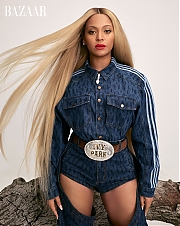
This collection is a mixture of my childhood growing up in Texas and a bit of American history. I grew up going to the Houston rodeo every year. It was this amazing diverse and multicultural experience where there was something for every member of the family, including great performances, Houston-style fried Snickers, and fried turkey legs. One of my inspirations came from the overlooked history of the American Black cowboy. Many of them were originally called cowhands, who experienced great discrimination and were often forced to work with the worst, most temperamental horses. They took their talents and formed the Soul Circuit. Through time, these Black rodeos showcased incredible performers and helped us reclaim our place in western history and culture. We were inspired by the culture and swag of the Houston rodeo. We combined classic elements with the athleticwear of IVY PARK x adidas, adding our own spin, monogrammed denim, chaps, and cowhide.
I’m excited that IVY PARK x adidas will now feature kids’ clothing with this drop. On our family vacations, we love to coordinate our outfits. My kids are usually on set with me for shoots, and we’d find ourselves putting them in extra-extra-smalls so we could match. So, it is a natural progression for IVY PARK to introduce a selection of key silhouettes in children’s sizing.
Tell us about your community. How have the women in your life influenced you?
My closest friends are brilliant women who run companies, are entrepreneurs, mothers, wives, and close family. Kelly [Rowland] and Michelle [Williams] are still my best friends. I gravitate toward strong, grounded women like my incredible sister, Solange. She is full of wisdom, and she is the dopest person I know.
There is power in community, and I saw that growing up the daughter of a salon owner. My first introduction to beautiful women was curvy, Texas-bred, bean-and-cornbread-fed goddesses. I was exposed to so many entrepreneurial women that I admired. Doctors, business owners, artists, teachers, mothers—they all came through my mom’s salon. I saw firsthand how a salon can be a sanctuary for women. I vividly remember one client who was an opera singer. She was this regal Black woman who had traveled all around the world and would tell these incredible stories. I’d love to hear about her travels and decided one day I would travel around the world too.
I watched my mother nurture and heal those women in her salon, not just by making them look and feel beautiful but by talking with them, listening to them, and connecting with them. I’ve seen how much Black women’s emotions are attached to our hair and beauty. The beauty industry does not always understand these emotions and what we need. I want to build a community where women of all races can communicate and share some of those secrets, so we can continue to support and take care of each other. I want to give women a space to feel their own strength and tell their stories. That is power.
With so much on your plate, how do you take care of yourself?
I think like many women, I have felt the pressure of being the backbone of my family and my company and didn’t realize how much that takes a toll on my mental and physical well-being. I have not always made myself a priority. I’ve personally struggled with insomnia from touring for more than half of my life. Years of wear and tear on my muscles from dancing in heels. The stress on my hair and skin, from sprays and dyes to the heat of a curling iron and wearing heavy makeup while sweating on stage. I’ve picked up many secrets and techniques over the years to look my best for every show. But I know that to give the best of me, I have to take care of myself and listen to my body.
In the past, I spent too much time on diets, with the misconception that self-care meant exercising and being overly conscious of my body. My health, the way I feel when I wake up in the morning, my peace of mind, the number of times I smile, what I’m feeding my mind and my body—those are the things that I’ve been focusing on. Mental health is self-care too. I’m learning to break the cycle of poor health and neglect, focusing my energy on my body and taking note of the subtle signs that it gives me. Your body tells you everything you need to know, but I’ve had to learn to listen. It’s a process to change habits and look past the bag of chips and the chaos everywhere!
During quarantine, I went from overindulgences to creating positive rituals drawing from past generations and putting my own spin on things. I discovered CBD on my last tour, and I’ve experienced its benefits for soreness and inflammation. It helped with my restless nights and the agitation that comes from not being able to fall asleep. I found healing properties in honey that benefit me and my children. And now I’m building a hemp and a honey farm. I’ve even got hives on my roof! And I’m so happy that my daughters will have the example of those rituals from me. One of my most satisfying moments as a mom is when I found Blue one day soaking in the bath with her eyes closed, using blends I created and taking time for herself to decompress and be at peace. I have so much to share…and there’s more to come soon!
Okay, we’ve waited long enough to ask…when can we expect new music?
With all the isolation and injustice over the past year, I think we are all ready to escape, travel, love, and laugh again. I feel a renaissance emerging, and I want to be part of nurturing that escape in any way possible. I’ve been in the studio for a year and a half. Sometimes it takes a year for me to personally search through thousands of sounds to find just the right kick or snare. One chorus can have up to 200 stacked harmonies. Still, there’s nothing like the amount of love, passion, and healing that I feel in the recording studio. After 31 years, it feels just as exciting as it did when I was nine years old. Yes, the music is coming!
What do you hope this next decade brings?
My wish is for my 40s to be fun and full of freedom. I want to feel the same freedom I feel on stage every day of my life. I want to explore aspects of myself I haven’t had time to discover and to enjoy my husband and my children. I want to travel without working. I want this next decade to be about celebration, joy, and giving and receiving love. I want to give all the love I have to the people who love me back.
I’ve done so much in 40 years that I just want to enjoy my life. It’s hard going against the grain, but being a small part of some of the overdue shifts happening in the world feels very rewarding. I want to continue to work to dismantle systemic imbalances. I want to continue to turn these industries upside down. I plan to create businesses outside of music. I have learned that I have to keep on dreaming. One of my favorite quotes is from the inventor Charles Kettering. It goes “Our imagination is the only limit to what we can hope to have in the future.”
I want to show that you can have fun and have purpose, be respectful and speak your mind. You can be both elegant and a provocateur. You can be curvy and still be a fashion icon. I wish this freedom for every person. I have paid my dues and followed every rule for decades, so now I can break the rules that need to be broken. My wish for the future is to continue to do everything everyone thinks I can’t do.
Hairstylist: Jawara; Personal Hairstylist for Beyoncé and Co-Hairstylist: Nakia Rachon; Hair Colorist: Rachel Bodt; Makeup Artist: Francesca Tolot; Manicurist: Miho Okawara; Production: Viewfinders; Set Designer: Peter Klein; Lighting Technician: Stephen Wordie. Special Thanks To Yvette Noel-Schure, Kaleb Steele, Andrew Makadsi, Lauren Baker, and Hillary Coy of Parkwood Entertainment.
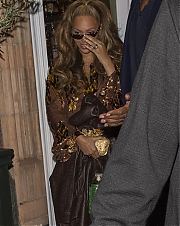


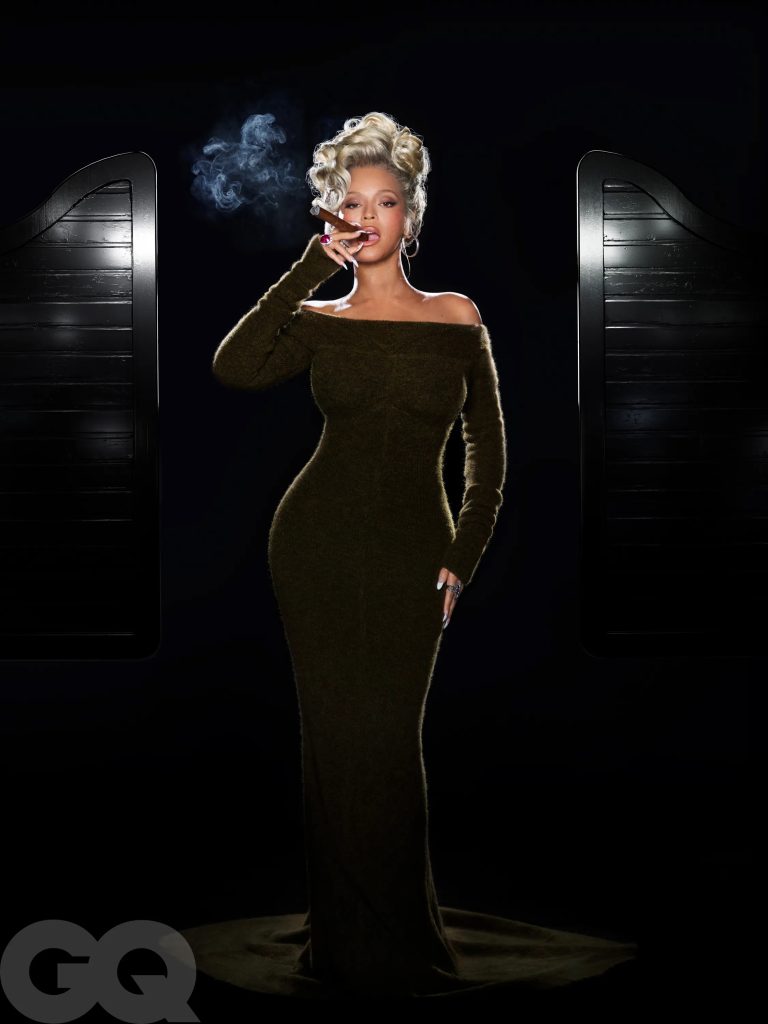


 She gave birth to her daughter Blue Ivy in January of last year. And Beyoncé admits in a new interview that it was the connection she felt to her unborn child that helped her through the pain of labour. ‘We were talking. I know it sounds crazy, but I felt a communication,’ said the 32-year-old in the November issue of Marie Claire Australia.
 Shawn Carter, better known as Jay Z, tells Vanity Fair contributing editor Lisa Robinson in the November issue that although his wife, Beyoncé, says that their 18-month-old daughter, Blue Ivy, prefers Jay’s music to hers, he’s not so sure. “That’s not true. She does like her mother’s music—she watches [Beyoncé’s concerts] on the computer every night. But my album came out and I don’t know if Blue ever heard any of my music prior to this album—she’s only 18 months old and I don’t play my music around the house. But this album was new, so we played it. And she loves all the songs. She plays a song and she goes, ‘More, Daddy, more . . . Daddy song.’ She’s my biggest fan. If no one bought the Magna Carta [album], the fact that she loves it so much, it gives me the greatest joy. And that’s not like a cliché. I’m really serious. Just to see her—‘Daddy song, more, Daddy.’ She’s genuine, she’s honest, because she doesn’t know it makes me happy. She just wants to hear it.”