
February 23, 2024

Beyoncé, The Boss

The mogul speaks on founding her new hair care line, Cécred, building a legacy and uniting the deeply personal with the professional.
BY BROOKLYN WHITE

Beyoncé Knowles-Carter wears quite a few hats. She juggles life as a married mother of three with being the greatest living entertainer—two undertakings that are brain- and body-bending separately, and nearly inconceivable when combined. Her pointed manicures are the needle under which global interest spins. One hip bounce, one social post, one brand mention: That’s all it takes to send the public into orbit. She’s mentor, mountain, and muse—every woman and every woman. Over the years she’s launched multiple ventures, including House of Deréon, Parkwood Entertainment, BeyGOOD and IVY PARK.

Her latest undertaking has technically been on the burner since her youth—but more tangibly since 2018. It branches from her family’s generational focus on hair, taking root in the idea of self-care as ritual. She first teased the project in May 2023 via Instagram, where fans assumed the sprays and pumps before her were filled with self-made hair elixirs. She, and all involved, have been characteristically mum about the offering—until now.

Beyonce for ESSENCE March/April Beauty Issue on stands Feb 27.

“Hair has always been a very big part of our lives,” says Ms. Tina Knowles. “Just as fashion saved our family, hair is how we made a living.” In Beyoncé’s formative years, Ms. Tina was a hairdresser who owned and operated her own salon. She says her career in cosmetology is but a continuation of what Black people have done for ages. “In the culture of Black folks, all the way from the beginning: If you could do some hair, you’ll never be broke,” she explains. “I told my kids that. My mama told me that. So it’s just our legacy, and this full-circle moment feels amazing.”

The brand is called Cécred, a portmanteau of the singer’s name and the reverence she has for her own hair, and others’. Throughout centuries and across nations, hair has symbolized power for both owners and institutions. It is almost treated as separate from the body and more in line with the inner being. In acknowledgment of hair’s distinct role in life and culture, and out of longstanding interest in its wellness, Beyoncé formulated the eight-piece collection, due out February 20 on Cécred.com. It includes a clarifying shampoo and scalp scrub, hydrating shampoo, moisturizing deep conditioner, a reconstructing treatment mask, a moisture-sealing lotion, a nourishing hair oil, a fermented rice and rose ritual treatment, and a “shaking vessel” that allows you to blend the ritual treatment. Together, they’ll strengthen and smooth the hair, and also help it recover from any damage. The entire line is made possible through the advent of a custom technology: a patent-pending bioactive keratin ferment. Naturally, it’s infused with honey.

Fittingly, Destiny’s Child first topped the Billboard Hot 100 with “Bills, Bills, Bills,” which had a music video that took place in a hair salon. It was an homage to the environment that birthed Beyoncé and is evidence of her enduring interest in hair. More recently, the music mogul’s “Formation” video included a scene shot in a beauty-supply store. Yet Beyoncé isn’t the first in her family to make hair products; her mother once blended up her own formulas, too. “Of course, I became a mixologist,” Ms. Tina says. “Back then there was no one product that mixed high-tech hair care with the nourishing moisturizers and oils so vital to textured or color-treated hair, so I mixed the two. I was told Black women’s hair could not have color and perm at the same time. I proved that theory wrong. Now Cécred has the latest science with tried-and-true rituals passed down from generations before.”

Ms. Tina’s parents were Louisiana natives, a fact Beyoncé declares with pride. As the singer’s grandmother, Agnéz Deréon, was coming up, an innovative entrepreneur, also from Louisiana, was becoming a pivotal presence in Black history. Madam C.J. Walker is regarded as the first woman to become a millionaire by her own means. Her cause was righteous. In the aftermath of the Reconstruction era, and with the introduction of Jim Crow, Black Americans continued to be socially and economically trampled, leaving many without the tools to effectively care for their hair. After experiencing her own hair trials, Walker blended well-known ingredients and founded an eponymous hair business. Of Walker, it was widely said that “as a hair grower, she has no equal.’’ She was a star who fought for her own glimmer—and was determined to help others uncover theirs as well. Those who understand the significance of her hair and scalp treatments intimately are able to recognize her sincerity and communal investment. Over 100 years later, another Southern, empire-minded talent is offering up her own hair recipes.

“My mom would say, ‘Go put some grease in your hair because it looks really dry,’ and that meant oiling it and keeping it moisturized,” Ms. Tina says of the messages she received in her family growing up. “So all of those things that my mom did, like using olive oil and honey and egg whites for the protein, were all good for our hair and also for a good old press. These are all tips from my mom, and she just passed them all down.”

The framing of Cécred as an ambitious stake in the earth, as well as Beyoncé’s rightful inheritance, cannot be understated. It is the fruit of her labor. Now, as the founder and chairwoman of her own hair care brand, she stands on the shoulders of women who loved her before she was born. She seeks to honor them at every turn, which means even the most minuscule aspects of the line were assiduously designed. Nothing can be amiss, because she feels that this is bigger than her. And, as she shares with ESSENCE, she’s ready for the past and the future to finally meet.

ESSENCE: You’ve talked about your experiences growing up in your mother’s salon. Can you tell us a bit more about your time there?

Beyoncé: I have vivid memories of my mother working as a hairstylist right from our home. She built a small salon at the back of our house, and I can recall catching glimpses of her while I watched cartoons or played with my dolls and toys. These moments are etched into every corner of my childhood memories.

I saw her shampooing and trimming hair, transforming women, leaving them feeling really good. Looking back, it was more than just a hair appointment—it was therapy. I worked in her salon, sweeping the floors and helping out where I could. I used to eavesdrop and listen in on their conversations intently. It was a sacred space for these women. She was so good and so talented that eventually, her clientele outgrew her at-home salon. So that’s when she opened her first hair salon, Headliners. I remember the early sketches and my mom inviting me to be a part of the design process, even though I was just a youngin’. But that’s my mother. Our family has always had the spirit of collaboration.

My mom had a roster of amazing clients at her salon, and while the environment was therapeutic for them, it was also for me. She found a therapist for me, during a period when I was extremely introverted and hardly spoke. It was in her salon that I realized my dreams of being a performer—inspired by one of her clients who happened to be an opera singer. I was captivated by her stories of a recent trip to Germany. In awe, I distinctly remember telling my mom that I wanted to be just like her client.
So much of the fabric of who I am came from her salon. It is something that just connects to all of my senses, and it’s a beautiful place to grow up. That’s my foundation—and I think as an artist, so much of my bold experimentation with hair comes from being inspired by art and sculptures; getting creative with braids; figuring out new techniques; and exploring ways to maintain hair growth with protective styles and wigs, while still feeling fabulous. It all stems from my experiences growing up in my mother’s salon.

You famously cut your hair into a pixie in 2013 and had swaths of women following suit. What can you share with us about that decision? Did it reflect a kind of life change?

It did. That’s right. I love how we associate a certain hairstyle with moments in our lives, like that short-hair moment. I remember the day I decided to just cut all my hair off. I didn’t have a particular style in mind. It wasn’t an aesthetic choice, but it was a very big emotional transformation and metamorphosis that I was going through. So much of my identity as a performer has been connected to flowing hair. Cutting my hair off was me rebelling against being this woman that society thinks I’m supposed to be. I was a new mother, and something about the liberation of becoming a mother made me want to just shed all of that. It was a physical representation of me shedding the expectations put upon me. I just wanted it off. Neal Farinah, my hairstylist and friend, was freaking out because it was really long, really thick and really healthy. I just got the scissors and chopped it off. It was very intentional. And it was what I needed to do. And after that, I became super brave. It was the first step to many more audacious decisions I made in my life and my career that have led to who I am now.

We’ve seen you rock an array of hairstyles—from braids to an Afro to teased curls—all while leaning into your signature blonde. How do you maintain hair health while having dyed hair?
What saves my hair is the technology in the formula we created for our Cécred products. It’s a fermentation made from honey and keratin that helps to stop my hair from breaking and brings the shine back. The technology in the products is effective enough that I don’t need to over-
manipulate my hair while I shampoo.

A lot of people don’t know how easy it is to have buildup on your hair from overusing the wrong products. The buildup prevents the hair from receiving the best results from the products. I try to be gentle with my hair. The lather in our silicone-free Clarifying Shampoo and Scalp Scrub is so relaxing, and it gets my hair and scalp so clean without stripping away the moisture.
In addition to using the products, I wear my hair pressed, colored, ironed and natural as much as I wear protective styles, depending on what I’m doing. I also use oil for my scalp underneath the braids. When I take my braids down, I focus on cleansing and moisturizing my hair before putting it back up into a protective style. I like to look at these routines more like rituals, because the care and love you give your hair is a special, intimate process that we tend to overlook.

What does the name Cécred mean to you? How did you come up with it?

I have many beautiful memories attached to my hair. The relationship we have with our hair is such a deeply personal journey. From spending my childhood in my mother’s salon to my father applying oil on my scalp to treat my psoriasis— these moments have been sacred to me.
The conversations and debates in the salons and barbershops create a sense of community for the people who look to it as a retreat from their everyday lives. For them, it’s a place to feel beautiful and vent, laugh, share secrets and pass down wisdom. It’s the most consistent community gathering we have. It’s so important that it’s a sanctuary.

I think that connection of community, mother and child, father and child, and respect— and allowing yourself to be taken care of, especially for Black women, who are always taking care of everyone else—it’s all sacred. So I took the end of my name, Cé, and made it the beginning of the word sacred to create Cécred. From my mother’s salon, daily rituals with my father, and years of experience in developing a hair care line, the journey has been just that: Cécred.

You’ve been an entrepreneur for nearly two decades. One of your earliest pursuits, House of Deréon, was done in collaboration with your mother, Tina Knowles. What are some words of wisdom you’ve gleaned from her?

I woke up this morning, said my prayers, and really thought about the fact that my mom and I have been talking about this [hair care line] since I was a teenager. And what an honor to be able to do something so special with my mother, and to be able to share that with the world. This is meaningful. She’s a visionary and a brilliant woman and has worked so hard on this brand alongside me. She’s such a gift, and this is a bit surreal for me that it is finally here. It feels like all of her life’s learning, her 70 years, and now my 42 years, are generational and meant to be. Honoring the legacy and the wisdom passed down through generations, and mixing it with science and technology, is part of this line. It was important that we borrowed some of our past and brought it into the future.

This is more than a business to you—it is a part of your birthright. How do you mingle the deeply personal with the professional while prioritizing that it remains sacred?

My priorities are quality and intention. It was important to decide where we invested in our formulations. I knew what I wanted to do, with technology that works for all women and all textures, because I had not been able to find it. I built this from the ground up and funded it myself. First, I had to find the right team with the best experience who also shared my beliefs. This business was led by heart and passion, not by a business plan. We went above and beyond to make decisions based on results and the absolute best science. And better results meant more investment in quality products. Every hair texture deserves testing, research and development. Black women in general are the last to be included in testing. We are often prescribed things based on studies we were not included in. It’s bigger than me, or hair. Now we have created something that celebrates healthy hair for all women, including us. I’m always honored to invest in us.

Cécred is a legacy project for me, one that’s probably the most rooted in my ancestry. It’s so far beyond business. Hair is our lineage; it’s our family story. Having access to proven ingredients, and creating our own technology that is patent-pending—we now have a line that works universally.

What’s your nightly hair routine? Are there any tips or tricks you incorporate?

It’s all about moisture for me—adding oil to my scalp and covering my hair at night so the oils could penetrate. It brings back such great memories of my rituals as a child to maintain a healthy scalp. I wrap my hair up and sometimes sleep in some cute rollers with a net or bonnet, depending on how I am wearing my hair. I try to avoid friction, my hair reverting and using unnecessary heat.

Black women’s sense of self is so often connected to their hair. How do we allow it to bring us joy and accentuate who we are, without it completely defining our personhood?

We can wear our hair natural, straight, braids, weaves and wigs. There’s power in self-expression and in feeling free to show up as we choose, in whatever hair we choose. For me, joy comes from making myself a priority and making my hair a priority. It is really important for me to make time for the sacred rituals of self-care.

One hair ritual I always used was fermented rice water. We put our own spin on it and figured out how to turn it into a powder. All you need to do is add water, so it’s much easier and instant— plus we added rose, so it smells beautiful. I do this when my hair needs it, after I color my hair, after a tour. It’s healing for my hair but also for me. I think one of the beautiful things that inspired this line was respecting these ancient traditions and mixing them with technology and science.

Who are you looking to serve with your hair care line?

I saw in my mother’s hair salon that any textured hair could be healthy and could have growth when properly nurtured. I learned that textured hair could be colored. That women of all races can have fun with different styles and still keep their hair healthy. I picked up many techniques from working with the best hairstylists in the world. Hair is not one-size-fits-all. I see certain types of hair that have multiple textures on one head. Depending on the porosity, the density, the thickness of your hair, if it’s color-treated, if your hair is relaxed—your prescription has to be personalized. I hope we can honor the sacred rituals of our past while providing education and cutting-edge science to the hair care community.

Being the boss is big business. The calls, the tests. Natural pauses and sign-offs. Limbs bent before a glowing laptop. It’s a winding cycle our Beyoncé knows well. It’s also one she embraces. We’ve seen her in action: intrinsically motivated, serious and fixed on a jaw-dropping outcome. It’s in these moments of construction that she’s in her flow, tinkering with the seemingly invisible pieces until all is in place. When you see it actualized, you realize there was never an insignificant part. A visionary knows that before the work has even begun.


In the world of Cécred, Beyoncé is dealing in two worlds she’s grown accustomed to. The separation of business and her heart’s callings isn’t present for her. Each commercial move appears to be guided by a deeper, personal purpose. This has brought about a noticeable freedom that we’ve seen surge through her yields in increasing amounts. Over 25 years into her mainstream career, she’s found her own way to guide, give meaning and let her hair down. Sacred indeed

Cécred, launches Feb 20 on cecred.com

Photographed by Andre D. Wagner

Written by Brooklyn White-Grier

Styled by Shiona Turini
Hair Stylist: Neal Farinah at Draped Collective using Cécred Hair Collection Makeup: Rokael using Rokael Beauty at Opus Beauty
Nail Technician: Miho Okawara (MiHONAiLS)
Set Design by Bette Adams at MHS Artists

Photography Assistants: Tyler Woodford and Juliet Wolf
Lighting Director: Tutu Lee
Lighting Team: Zack Bartlett, Jake Reardon, Hisham Abahusayn, and Jason Capistrano Digital Technician: Maria Toncoso Gibbs

Wardrobe Supervisor: Ryan Dodson at Parkwood
Stylist Assistants: Milton Dixon, EJ Ellison, and Jaiin Kang
Hair Team: Nakia Rachon at Parkwood, Ziff Anthony
Makeup Assistant: Sarah Thacker
Nail Assistant: Ayumi Namaizawa
Set Assistants: Nicky Buzzerio, Christian Senrud, George Deacon, M Czerwinski, Graham Law, and David Rose
Tailors: Tim White and Shirlee Idzakovich
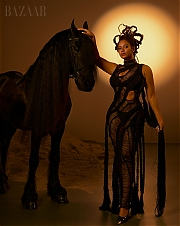
August 10, 2021

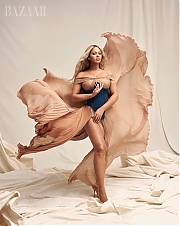
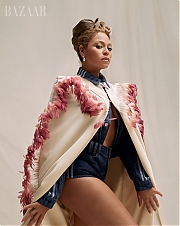
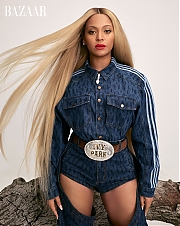
Harper’s Bazaar: Beyoncé’s Evolution

After more than two decades in the spotlight, Beyoncé has become much more than a pop icon. She’s a cultural force who has routinely defied expectations and transformed the way we understand the power of art to change how we see ourselves and each other. But at 40, she feels like she’s just scratched the surface.

INTRODUCTION BY KAITLYN GREENIDGE; PHOTOGRAPHS BY CAMPBELL ADDY; STYLING BY SAMIRA NASR AND MARNI SENOFONTE

Women born at the dawn of the 1980s were among the last generation to live an analog life and the first to see themselves reimagined in digital. Beyoncé’s childhood coincided with the rise of home-recording equipment—video cameras, stereo systems that let you record your own voice, keyboards that let you find whatever sound you wanted, personal computers to synthesize it all. The girls before her had mirrors and the echoes of the trees and magazines with cartoon approximations to reflect themselves. Her generation was the first to regularly experience the dizzying accuracy of playback. It could be a destabilizing force; there’s your voice as you think it sounds, and then your voice when it comes back to you, after you’ve hit Record.

Beyoncé Knowles-Carter came of age during that digital revolution, and knowing how to navigate that dissonance is part of her artistic superpower. She has built her company, Parkwood Entertainment, into a media conglomerate that includes a fashion line, IVY PARK. She is now a mother of three, to nine-year-old Blue Ivy and four-year-old twins Rumi and Sir, with husband JAY-Z. The iconic couple has just been named the new faces of Tiffany & Co., which was acquired earlier this year by LVMH and is relaunching under its auspices. And she is working on new music along with an array of other projects that promise to obliterate old boundaries and vault her further into uncharted territory.

Is that what I sound like? Is that what I want to send into the world? These are questions she answers anew, each decade of her life. Now, at 40, Beyoncé listens to her voice alone.

You turn 40 on September 4. Reflecting on your life so far, what has each decade taught you?

The first decade of my life was dedicated to dreaming. Because I was an introvert, I didn’t speak very much as a child. I spent a lot of time in my head building my imagination. I am now grateful for those shy years of silence. Being shy taught me empathy and gave me the ability to connect and relate to people. I’m no longer shy, but I’m not sure I would dream as big as I dream today if it were not for those awkward years in my head.

I was competing in dance and singing competitions at age seven. When I was on the stage, I felt safe. I was often the only Black girl, and it was then that I started to realize I had to dance and sing twice as hard. I had to have stage presence, wit, and charm if I wanted to win. I started taking voice lessons from an opera singer at nine. By 10 I had already recorded at least 50 or 60 songs in the recording studio. This was before Pro Tools, when you recorded to tape.

I had my first vocal injury at 13 from singing in the studio for too many hours. We had just gotten our first record deal, and I was afraid I had developed nodules and destroyed my voice and that my career could be over. The doctors put me on vocal rest all summer and I was silent once again.

My teenage years were about the grind. I grew up hearing this particular scripture from James 2:17, “Faith without work is dead.” Vision and intention weren’t enough; I had to put in the work. I committed to always being a student and always being open to growth. No one in my school knew that I could sing because I barely spoke. My energy went into Destiny’s Child and the dream of us getting a record deal and becoming musicians. If something wasn’t helping me reach my goal, I decided to invest no time in it. I didn’t feel like I had time to “kiki” or hang out. I sacrificed a lot of things and ran from any possible distraction. I felt as a young Black woman that I couldn’t mess up. I felt the pressure from the outside and their eyes watching for me to trip or fail. I couldn’t let my family down after all the sacrifices they made for me and the girls. That meant I was the most careful, professional teenager and I grew up fast. I wanted to break all of the stereotypes of the Black superstar, whether falling victim to drugs or alcohol or the absurd misconception that Black women were angry. I knew I was given this amazing opportunity and felt like I had one shot. I refused to mess it up, but I had to give up a lot.

My 20s were about building a strong foundation for my career and establishing my legacy. I was focused on commercial success and number ones and being a visionary no matter how many barriers I had to break through. I was pushed to my limits. I learned the power of saying no. I took control of my independence at 27 and started Parkwood Entertainment. At the time, there wasn’t a company that did what I needed it to do or ran the way I wanted it run. So, I created this multipurpose badass conglomerate that was a creative agency, record label, production company, and management company to produce and work on projects that meant the most to me. I wanted to manage myself and have a company that put art and creativity first.

I pulled together these young visionaries and independent thinkers to collaborate with. I wanted strong women to be in key roles throughout my company, when most of the industry was still male dominated. I wanted collaborators who had not been jaded by the corporate world and wouldn’t be afraid to rock with me when I came up with unconventional ideas, a team that would challenge me but wouldn’t be conditioned to say you’re not supposed to do something.

I remember being in a meeting discussing analytics, and I was told the research discovered that my fans did not like when my photography was black and white. They told me I wouldn’t sell if it wasn’t in color. That was ridiculous. It pissed me off that an agency could dictate what my fans wanted based on a survey. Who did they ask? How is it possible to generalize people this much? Are these studies accurate? Are they fair? Are all the people I’m trying to uplift and shine a light on included? They’re not. It triggered me when I was told, “These studies show…” I was so exhausted and annoyed with these formulaic corporate companies that I based my whole next project off of black and white photography, including the videos for “Single Ladies” and “If I Were a Boy” and all of the artwork by Peter Lindbergh for I Am…Sasha Fierce, which ended up being my biggest commercial success to date. I try to keep the human feeling and spirit and emotion in my decision-making.

I was very interested in filmmaking, and my first project was directing my concert film I Am…World Tour. I learned how to edit the cut myself in Final Cut Pro, and it was the beginning of a newfound love and creative expression, which led to creating the visual album with my self-titled album, Beyoncé, then Lemonade, Homecoming, and Black Is King.

My 30s were about starting my family and my life becoming more than my career. I worked to heal generational trauma and turned my broken heart into art that would help move culture forward and hopefully live far beyond me. My 30s were about digging deeper. In 2013, I started BeyGOOD to share the mentality that we could all do something to help others, something my parents instilled in me from a young age—to inspire others to be kind, to be charitable, and to be good. We focused on many areas of need, including hurricane relief, education with scholarships to colleges and universities in the U.S., a fellowship program in South Africa, women’s rights, support of minority businesses, assisting families with housing needs, water crises, pediatric health care, and pandemic relief. BeyGOOD has become a worldwide initiative for providing support domestically and internationally. It has always been important to me to help others and to make a positive impact on the world. I have worked to lift my people up, to change perceptions so my kids could live in a world where they are seen, celebrated, and valued.

I’ve spent so many years trying to better myself and improve whatever I’ve done that I’m at a point where I no longer need to compete with myself. I have no interest in searching backwards. The past is the past. I feel many aspects of that younger, less evolved Beyoncé could never f*** with the woman I am today. Haaa!

How do you process the changing world of celebrity culture and protect your inner self?

We live in a world with few boundaries and a lot of access. There are so many internet therapists, comment critics, and experts with no expertise. Our reality can be warped because it’s based on a personalized algorithm. It shows us whatever truths we are searching for, and that’s dangerous. We can create our own false reality when we’re not fed a balance of what’s truly going on in the world. It’s easy to forget that there’s still so much to discover outside of our phones. I’m grateful I have the ability to choose what I want to share. One day I decided I wanted to be like Sade and Prince. I wanted the focus to be on my music, because if my art isn’t strong enough or meaningful enough to keep people interested and inspired, then I’m in the wrong business. My music, my films, my art, my message—that should be enough.

Throughout my career, I’ve been intentional about setting boundaries between my stage persona and my personal life. My family and friends often forget the side of me that is the beast in stilettos until they are watching me perform. It can be easy to lose yourself very quickly in this industry. It takes your spirit and light, then spits you out. I’ve seen it countless times, not only with celebrities but also producers, directors, executives, etc. It’s not for everyone. Before I started, I decided that I’d only pursue this career if my self-worth was dependent on more than celebrity success. I’ve surrounded myself with honest people who I admire, who have their own lives and dreams and are not dependent on me. People I can grow and learn from and vice versa. In this business, so much of your life does not belong to you unless you fight for it. I’ve fought to protect my sanity and my privacy because the quality of my life depended on it. A lot of who I am is reserved for the people I love and trust. Those who don’t know me and have never met me might interpret that as being closed off. Trust, the reason those folks don’t see certain things about me is because my Virgo ass does not want them to see it….It’s not because it doesn’t exist!

How did your upbringing influence your art and business?

My mother has always been my Queen and still is. She has always been so strong and is filled with humanity. She worked 18 hours a day with calloused hands and swollen feet. No matter how tired she was, she was always professional, loving, and nurturing. I try to handle my work and run my company in the same way.

My father constantly encouraged me to write my own songs and create my own vision. He is the reason I wrote and produced at such a young age. I remember when I started hearing people criticize me after I had put on some weight. I was 19. None of the sample clothes fit me. I was feeling a bit insecure from hearing some of the comments, and I woke up one day and refused to feel sorry for myself, so I wrote “Bootylicious.” It was the beginning of me using whatever life handed me and turning it into something empowering to other women and men who were struggling with the same thing.

Fashion can often help to empower us too. Can you tell us about the inspiration behind your new IVY PARK collection?

This collection is a mixture of my childhood growing up in Texas and a bit of American history. I grew up going to the Houston rodeo every year. It was this amazing diverse and multicultural experience where there was something for every member of the family, including great performances, Houston-style fried Snickers, and fried turkey legs. One of my inspirations came from the overlooked history of the American Black cowboy. Many of them were originally called cowhands, who experienced great discrimination and were often forced to work with the worst, most temperamental horses. They took their talents and formed the Soul Circuit. Through time, these Black rodeos showcased incredible performers and helped us reclaim our place in western history and culture. We were inspired by the culture and swag of the Houston rodeo. We combined classic elements with the athleticwear of IVY PARK x adidas, adding our own spin, monogrammed denim, chaps, and cowhide.

I’m excited that IVY PARK x adidas will now feature kids’ clothing with this drop. On our family vacations, we love to coordinate our outfits. My kids are usually on set with me for shoots, and we’d find ourselves putting them in extra-extra-smalls so we could match. So, it is a natural progression for IVY PARK to introduce a selection of key silhouettes in children’s sizing.

Tell us about your community. How have the women in your life influenced you?

My closest friends are brilliant women who run companies, are entrepreneurs, mothers, wives, and close family. Kelly [Rowland] and Michelle [Williams] are still my best friends. I gravitate toward strong, grounded women like my incredible sister, Solange. She is full of wisdom, and she is the dopest person I know.

There is power in community, and I saw that growing up the daughter of a salon owner. My first introduction to beautiful women was curvy, Texas-bred, bean-and-cornbread-fed goddesses. I was exposed to so many entrepreneurial women that I admired. Doctors, business owners, artists, teachers, mothers—they all came through my mom’s salon. I saw firsthand how a salon can be a sanctuary for women. I vividly remember one client who was an opera singer. She was this regal Black woman who had traveled all around the world and would tell these incredible stories. I’d love to hear about her travels and decided one day I would travel around the world too.

I watched my mother nurture and heal those women in her salon, not just by making them look and feel beautiful but by talking with them, listening to them, and connecting with them. I’ve seen how much Black women’s emotions are attached to our hair and beauty. The beauty industry does not always understand these emotions and what we need. I want to build a community where women of all races can communicate and share some of those secrets, so we can continue to support and take care of each other. I want to give women a space to feel their own strength and tell their stories. That is power.

With so much on your plate, how do you take care of yourself?

I think like many women, I have felt the pressure of being the backbone of my family and my company and didn’t realize how much that takes a toll on my mental and physical well-being. I have not always made myself a priority. I’ve personally struggled with insomnia from touring for more than half of my life. Years of wear and tear on my muscles from dancing in heels. The stress on my hair and skin, from sprays and dyes to the heat of a curling iron and wearing heavy makeup while sweating on stage. I’ve picked up many secrets and techniques over the years to look my best for every show. But I know that to give the best of me, I have to take care of myself and listen to my body.

In the past, I spent too much time on diets, with the misconception that self-care meant exercising and being overly conscious of my body. My health, the way I feel when I wake up in the morning, my peace of mind, the number of times I smile, what I’m feeding my mind and my body—those are the things that I’ve been focusing on. Mental health is self-care too. I’m learning to break the cycle of poor health and neglect, focusing my energy on my body and taking note of the subtle signs that it gives me. Your body tells you everything you need to know, but I’ve had to learn to listen. It’s a process to change habits and look past the bag of chips and the chaos everywhere!

During quarantine, I went from overindulgences to creating positive rituals drawing from past generations and putting my own spin on things. I discovered CBD on my last tour, and I’ve experienced its benefits for soreness and inflammation. It helped with my restless nights and the agitation that comes from not being able to fall asleep. I found healing properties in honey that benefit me and my children. And now I’m building a hemp and a honey farm. I’ve even got hives on my roof! And I’m so happy that my daughters will have the example of those rituals from me. One of my most satisfying moments as a mom is when I found Blue one day soaking in the bath with her eyes closed, using blends I created and taking time for herself to decompress and be at peace. I have so much to share…and there’s more to come soon!

Okay, we’ve waited long enough to ask…when can we expect new music?

With all the isolation and injustice over the past year, I think we are all ready to escape, travel, love, and laugh again. I feel a renaissance emerging, and I want to be part of nurturing that escape in any way possible. I’ve been in the studio for a year and a half. Sometimes it takes a year for me to personally search through thousands of sounds to find just the right kick or snare. One chorus can have up to 200 stacked harmonies. Still, there’s nothing like the amount of love, passion, and healing that I feel in the recording studio. After 31 years, it feels just as exciting as it did when I was nine years old. Yes, the music is coming!

What do you hope this next decade brings?

My wish is for my 40s to be fun and full of freedom. I want to feel the same freedom I feel on stage every day of my life. I want to explore aspects of myself I haven’t had time to discover and to enjoy my husband and my children. I want to travel without working. I want this next decade to be about celebration, joy, and giving and receiving love. I want to give all the love I have to the people who love me back.

I’ve done so much in 40 years that I just want to enjoy my life. It’s hard going against the grain, but being a small part of some of the overdue shifts happening in the world feels very rewarding. I want to continue to work to dismantle systemic imbalances. I want to continue to turn these industries upside down. I plan to create businesses outside of music. I have learned that I have to keep on dreaming. One of my favorite quotes is from the inventor Charles Kettering. It goes “Our imagination is the only limit to what we can hope to have in the future.”

I want to show that you can have fun and have purpose, be respectful and speak your mind. You can be both elegant and a provocateur. You can be curvy and still be a fashion icon. I wish this freedom for every person. I have paid my dues and followed every rule for decades, so now I can break the rules that need to be broken. My wish for the future is to continue to do everything everyone thinks I can’t do.

Hairstylist: Jawara; Personal Hairstylist for Beyoncé and Co-Hairstylist: Nakia Rachon; Hair Colorist: Rachel Bodt; Makeup Artist: Francesca Tolot; Manicurist: Miho Okawara; Production: Viewfinders; Set Designer: Peter Klein; Lighting Technician: Stephen Wordie. Special Thanks To Yvette Noel-Schure, Kaleb Steele, Andrew Makadsi, Lauren Baker, and Hillary Coy of Parkwood Entertainment.

February 22, 2017

B’Day Era Photoshoot Update

We have added a couple outtakes from the B’day era. We don’t always post when we add photos to the gallery, so sometimes it’s easier to keep checking out BeyoncePictures.Com!

Tony Duran’s Seventeen Magazine Shoot
Beyonce's Tony Duran Shoot For Seventeen Magazine Beyonce's Tony Duran Shoot For Seventeen Magazine Beyonce's Tony Duran Shoot For Seventeen Magazine Beyonce's Tony Duran Shoot For Seventeen Magazine Beyonce's Tony Duran Shoot For Seventeen Magazine

B’Day Promo Shoot
Beyonce's B'Day Promo Shoot Beyonce's B'Day Promo Shoot Beyonce's B'Day Promo Shoot Beyonce's B'Day Promo Shoot

May 01, 2015

PHOTOSHOOT FRIDAY: Instyle Mag 2008

Photoshoot Friday is something new that we are trying here, where we bring fans photoshoots that are unseen, rare, or better quality. Today we are bringing you some HQ photos from Beyonce’s 2008 Instyle Magazine shoot, and we also have a couple different shots that are quite rare. If you check out the photos in the album, the ones added today are marked HQ.

February 18, 2015

EXCLUSIVE: Beyonce L’Oreal Outtakes

In 2013, Beyonce shot commercial and ads for L’Oreal’s Feria & Infallible campaigns. We have added some exclusive outtakes from the shoots’ set. Make sure you check them out in the gallery.

Due to the disdain of the BeyHive, we have removed the photos. We don’t want to cause any drama, nor do we wish to start fan wars. Some of the things we have seen posted were just horrible, and we don’t want any parts of it. We were just posting the photos to share the fact that our queen is naturally beautiful, at the same time she is just a regular woman.

In case you forgot…